
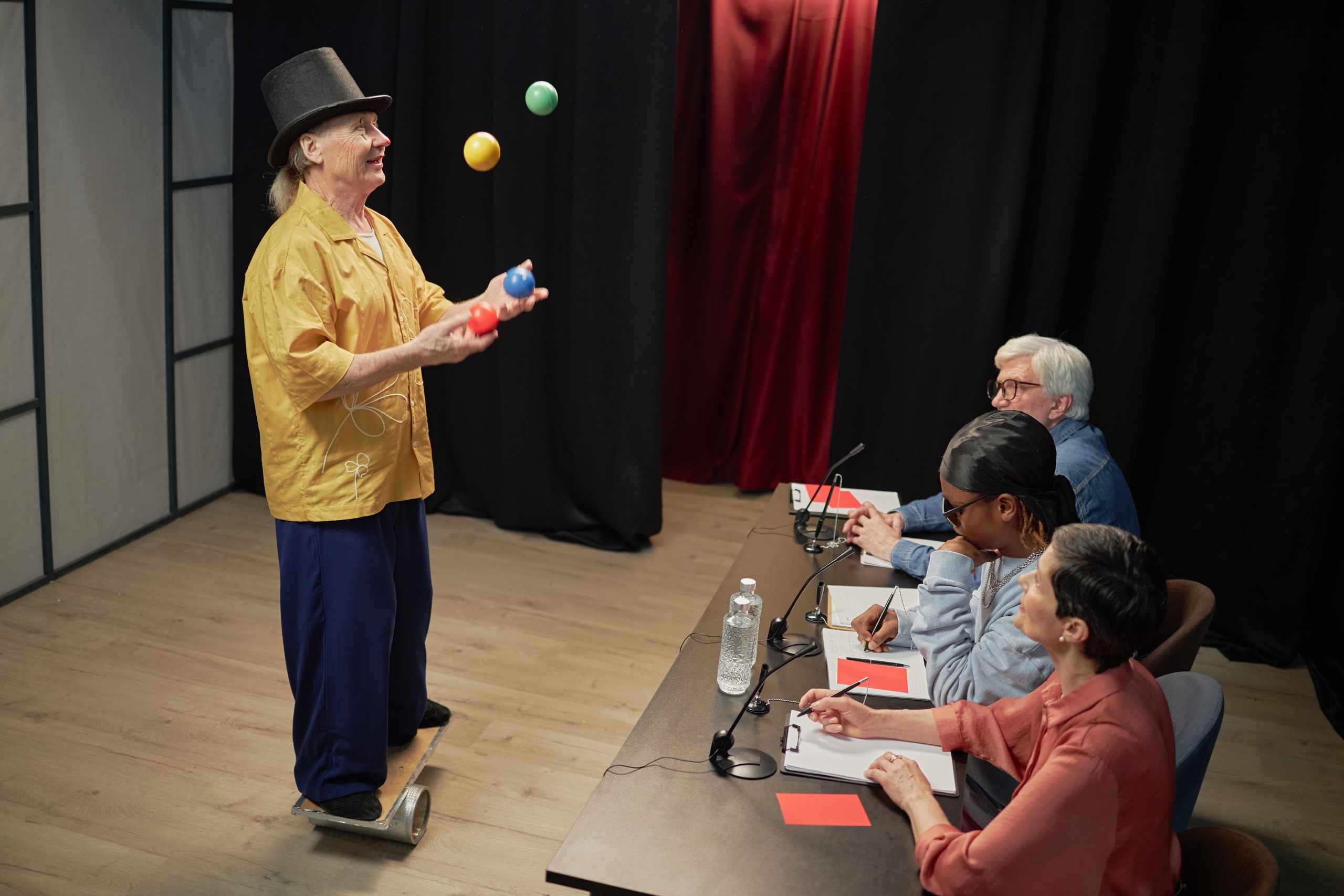
Your body will go numb even if you know your lines, even when you have the script in your hand, and even when the moment comes. In fact, you can find yourself in the middle of the scene, your body feeling like it has suddenly turned to ice and your hands don’t know what to do with themselves; the feet don’t know where to go; the shoulders have moved up to your ears; and your body just doesn’t want to move at all. This doesn’t necessarily mean you haven’t prepared, or that you haven’t memorized your lines, or that you’re nervous. Sometimes all this means is that your focus has gotten a little too narrow. When you worry about knowing your lines, you’re nervous, you need to look natural, and you’re making a character choice, your body is no longer available to you.
This can happen in little ways before it becomes blatant. Maybe your body stops breathing or your knees go hard, or your neck feels tight, or every motion feels forced. Your voice will stop working if the body doesn’t work for you. It is far more helpful to give your body one specific thing to do in a scene than to try to do something that will look random and unfocused. Try to find out what your body’s function can be in a situation. A body with a job can be much more open and available than a body told to just “relax.”
Look at the objective of the character as the first clue. If the character is seeking to be believed, perhaps that means you need to be more present, more direct toward the scene partner. If the character doesn’t want to answer, perhaps you don’t. If you don’t want to answer, turn away from the questioner or take a small step backward. If the character is trying to be convincing, stillness and a strong eye focus might be more appropriate than pacing. If your body is in the scene simply moving for the sake of looking like you’re working, you can find yourself more and more confused. You should find out what’s happening for your body in the scene to further what the character is trying to do.
An exercise that is very helpful in a rehearsal is to select a short exchange in the scene to be done as simply as possible. Begin in the scene, standing, and just say your lines with one gesture. Maybe you’ll take a step forward to express the fact that the character is getting more direct about what’s going on, or maybe you’ll sit as the character begins to express discomfort. Repeat the same scene again, paying attention to whether that gesture clarified the dialogue. If it took away your ability to listen, to breathe, to respond to your scene partner, try making that physical choice even smaller, or find something else that the body can do.
Your hands can become a major stumbling block in a scene for younger actors and beginners. Don’t leave them at your sides, holding them stiffly, or moving them with each line. You must find some reason, if at all possible, that the hands can do something: You’re holding the page of the play; You touch the chair to help yourself decide to sit down; You touch your arm because the character is uncomfortable; or You keep your hands still because the character doesn’t want to give anything away. The hands are much more interesting and more believable if you give them some motivation.
Being more aware of your scene partner can help you get unstuck. When you’re listening to a partner, trying to catch a cue, the reaction may come naturally: a slight change in your posture or gaze. Your body responds in many different ways to being challenged or ignored or asked for something or interrupted. Try to pay more attention to your scene partner than to yourself as you rehearse. That gets you off your self-conscious game of trying to find a pose. A moment can become more alive if it begins with an attentive pause, not a pause out of uncertainty.
Constant movement can be a sign that you’re not working in the scene. You want a body that isn’t frozen, but not one that is constantly busy. A body that can stay where it is and not look frozen but move without looking frantic, without moving just for the sake of moving. After you finish rehearsing a scene, evaluate your choices. Did your physical decisions and actions, the way that you stood, breathed, and moved, allow your audience to see what was happening in the scene? If you’re not certain, make it as clear and as simple as possible. You will create much more of an impression of presence with one clear step, one clear turn to face the other person, and one clear pause, than you will with a scene covered in constant motion.